


Sustainability, Biophilic Acoustics & LEED v5 in Europe
How biophilic and acoustic materials can strengthen a sustainability strategy, and streamline the documentation expected in LEED v5 processes in the European market.
Table of contents
#Why LEED v5 is a game-changer in Europe
LEED v5 shifts sustainability: from an accumulation of "good intentions" to a logic of demonstrable performance. For project teams, this changes how materials and products are specified, documented and justified.
A biophilic wall remains a strong design choice. But in LEED v5, its value becomes clearer when it fits within measurable outcomes: carbon reduction trajectories, a healthy indoor environment, usage resilience and long-term durability.
In Europe, LEED v5 is fully applicable and integrates regional alternatives (RACP) to better align with local frameworks, standards and market expectations. The idea is simple: LEED v5 does not impose a single model. It adapts to the European context while maintaining a demanding performance logic.
Concrete takeaway: if a product cannot be presented with clear documentation, a precise scope and stable long-term behavior, it becomes harder to integrate into a sustainability strategy, even if it is visually compelling.
#Impact areas, applied to interiors
LEED v5 is structured around three impact areas: decarbonization, quality of life, and ecological conservation and restoration. In parallel, equity and resilience cut across all themes, reinforcing systemic expectations.
Decarbonization
- What is the embodied carbon level of the installed elements?
- Can we measure and reduce these impacts early enough to guide specification?
- Are we designing for durability and adaptability, to avoid premature renovations?
Quality of Life
- Are we protecting indoor air quality and sensory comfort in occupied spaces?
- Do occupants benefit from a calmer acoustic environment and a restorative connection with nature?
- Is the strategy deployed at project scale, or limited to a single gesture?
Ecological Conservation and Restoration
- Are products responsibly sourced, traceable, and compatible with circular thinking?
- Can systems be repaired, maintained, or partially replaced without demolition?
- Do sourcing choices support better practices over time?
Biophilic and acoustic choices can contribute to all three areas, provided they are thought of as coherent, documented and measurable systems.
#What gets harder at the highest level
LEED v5 raises requirements, especially for projects targeting the highest certification levels. This pushes structural decisions upstream: material and product selection, carbon trajectory, air quality approach, longevity.
For interior fit-outs, the implication is direct. Product choices must fit into a coherent decarbonization and health narrative, with usable documentation for reviews.
In Europe, LEED v5 also marks a structural transition period: registrations are open, and previous versions (v4/v4.1) remain available until June 2026. This gives teams time to adapt, but the direction is clear.
#Materials: a carbon and health decision
In LEED v5, materials are no longer a "checkbox". They directly participate in the sustainability narrative, particularly through embodied carbon and transparency expectations in product selection.
This changes the conversation with suppliers. The question is no longer "is it sustainable?", but rather: "can you provide usable documentation on carbon data, emissions approach, sourcing, and end-of-life scenarios?"
LEED v5 relies more on longer time horizons to evaluate carbon outcomes. For interiors, a pragmatic reading is to avoid choices that lock in high replacement frequencies or generate unpredictable maintenance needs.
In Europe, the emphasis on measurable performance is often reinforced by the use of the Arc platform for monitoring and data management, particularly when operational performance must be demonstrated.

What this means for biophilic and acoustic products
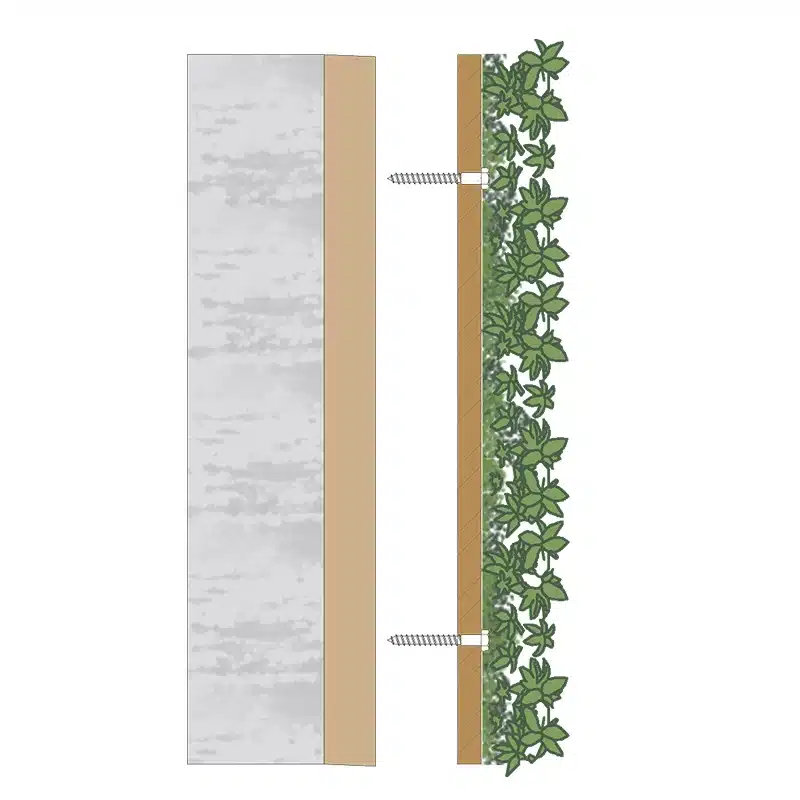
- Assembly clarity : a clear scope, with no gray areas.
- Emissions control : choices compatible with indoor air quality in occupied spaces.
- Sourcing transparency : avoiding vague statements, favoring traceable attributes.
- Sustainability : reducing replacement cycles and waste.
#Truly defensible biophilic strategies
Biophilic design is often reduced to a sensation. In a performance-oriented framework, it becomes more convincing when it relies on a reproducible strategy and real effects for occupants.
Concretely, this means biophilia must be present where people live and work daily, not only in circulation areas or as a single spectacular element. It must remain stable over time so the experience does not degrade.
What does "sustained engagement with nature" look like in a space
- Biophilic elements in daily-use areas, not just lobbies.
- Multiple touchpoints at floor-plan scale, so the experience is repeated.
- Integration with lighting and layout to make textures and depth readable.
- Clear maintenance guidelines, and visual stability over time.
Stabilized systems can be relevant in commercial settings, as they avoid irrigation and growth-related variables. This stability allows predictable behavior, compatible with performance-oriented approaches.
#Acoustic comfort as a quality-of-life lever
Acoustics is still too often treated as a last-minute technical layer. Yet noise directly affects concentration, recovery, stress and privacy.
This is why acoustic comfort increasingly joins sustainability topics. A space that "checks the boxes" but remains difficult to use triggers rework, additional materials, and sometimes early renovations.

Acoustics that support a "quality of life" narrative
- Sound zoning : clear sensory gradients based on usage.
- Retreat spaces : reducing overload in open environments.
- Absorption where it is needed : open space, collaboration, transitions.
- Material integrity : maintaining performance over time.
One of the most sustainable interiors is one that does not need to be redone. Acoustic comfort protects longevity.
#Specifying biophilic acoustic systems responsibly
Biophilic and acoustic materials strengthen a sustainability strategy when specified with a "system" approach. This includes composition, assembly, installation, and behavior over time.
Four specification principles suited to LEED v5 contexts
- Assembly clarity: define what is included and what is not, including backing, frame and fixings.
- Emissions control: limit uncontrolled on-site adhesives when possible, and document the installation method.
- Adaptability: favor reconfigurable or partially replaceable systems.
- Maintainability: make maintenance simple, documented and compatible with occupied-building operations.
#The documentation teams truly need
Most certification difficulties do not come from performance itself. They come from missing documents, unclear scope, or claims that cannot be justified at the time of review.
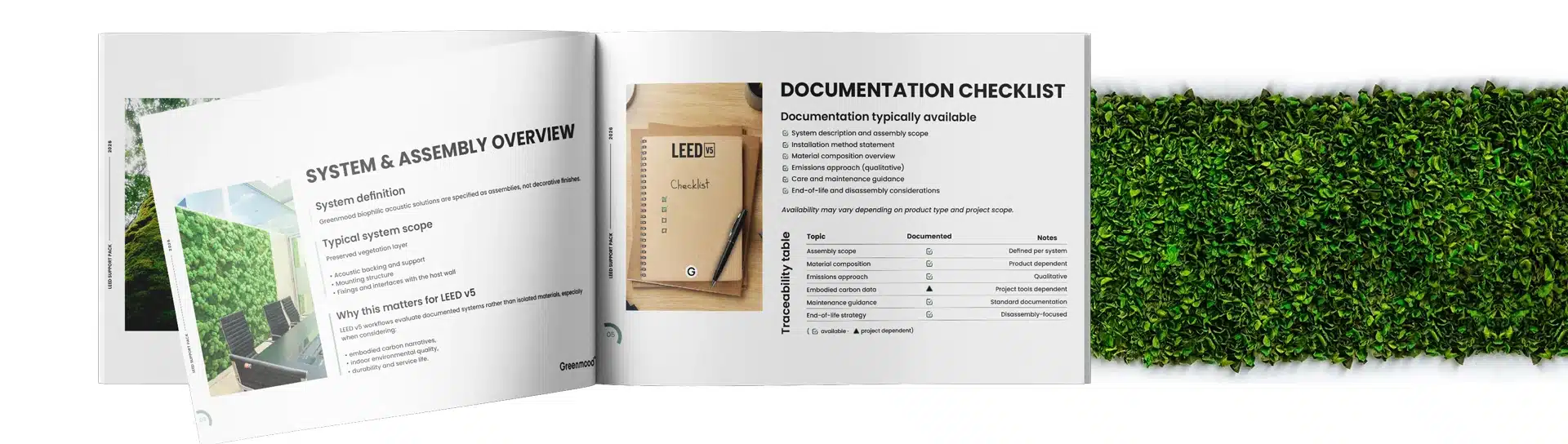
A robust documentation pack typically includes
- Assembly description (layers, materials, interfaces).
- Implementation note with clearly defined scope and limits.
- Emissions approach relevant for indoor environmental quality approaches.
- Embodied carbon elements (composition, scope, useful data for assessment tools).
- Maintenance guidelines to ensure stable long-term behavior.
- End of life : disassembly, separation, reuse and recycling.
Important note: we provide documentation intended to help project teams with certification and compliance processes. Final credit applicability depends on scope, framework and consultant analysis.
#Mistakes that weaken sustainability narratives
These situations regularly create difficulties during reviews, even when the design intent is solid.
Sustainability is not only about what is installed. It is also about the project's ability to remain relevant over time.
#Greenmood's approach to sustainability alignment
Underestimating acoustics, then replacing finishes after usage feedback.
What this means in practice
- Stabilized plants selected for their long-term stability and consistent appearance.
- Acoustic integration designed to improve daily comfort, not just visual impact.
- Clear assembly documentation to reduce ambiguity during specification and reviews.
- Focus on maintainability and maintenance planning compatible with occupied-building operations.
When biophilic systems are specified as durable assemblies, with real effects for occupants, they integrate more easily into LEED v5 strategies and certification reviews in Europe.
#Resources
If you are building a LEED v5 narrative in Europe, these resources can help align vocabulary, documentation expectations and review logic used by project teams and consultants.
Official LEED v5 references
Analyses and perspectives
- European Commission: LEED alignment, EU taxonomy and European market
- CBRE: LEED v5 as a strategic framework for compliant and resilient buildings
- Buro Happold: why LEED v5 raises the bar
Key takeaway
Biophilic and acoustic materials can contribute very concretely to a LEED v5 strategy in Europe. It all comes down to documentation and long-term stability. Treat these systems as measurable assemblies, integrate them into the occupant experience, and rely on evidence that holds up at review time.